Introduction
Are you tired of feeling like your small business is stuck in neutral, even though you are working around the clock? Hitting the Scaling Wall is incredibly common for entrepreneurs who try to manage rapid growth by focusing only on one area, like marketing or sales, while neglecting the critical infrastructure needed to support it. To achieve truly sustainable growth, you need a cohesive plan that links funding, operations, and talent development into a powerful ecosystem. This guide distills decades of expertise into five essential, interconnected steps, giving you a clear, actionable roadmap for rapid small business growth and helping you finally achieve the consistent scale you’ve been dreaming of.
Why Your Small Business Growth Stops (The Scaling Wall)
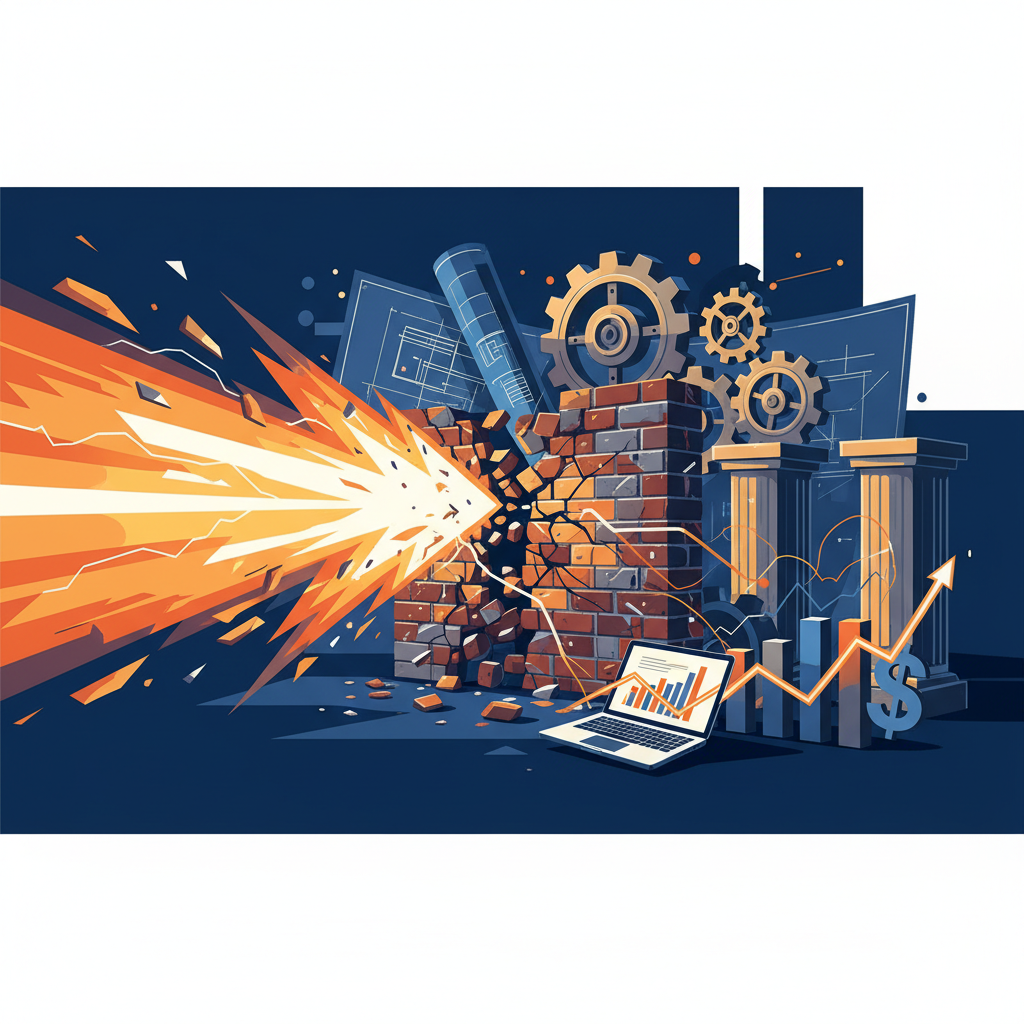
When a small business hits a plateau, it often feels like a single, overwhelming roadblock. This inability to progress is what many entrepreneurs call the Scaling Wall. This wall appears when organizational methods and lean systems that successfully supported $100,000 in revenue fail completely when trying to manage volume at $500,000 or $1 million.
Step 1: Stop Guessing—Find Your Real Growth Limits
Before you can push past this wall, you must stop guessing what the problem is and accurately diagnose your real constraints. Many business owners waste resources trying to fix a marketing problem when the root cause is operational capacity, or vice versa. This misdirected effort only stalls growth further.
To identify your limits, ask tough questions about where the stress points appear in your business infrastructure:
- Process Limits: Are you turning away new contracts or delaying shipments because your team physically cannot deliver the service or product on time?
- People Limits: Are you unable to hit ambitious digital marketing targets because you lack the specialized staff required to run complex campaigns or service incoming leads effectively?
- Money Limits: Are you constantly delaying necessary equipment upgrades or bulk inventory purchases because your existing cash flow is too tight?
- Standardize and Document: Create robust Standard Operating Procedures (SOPs) for every critical, repeatable task. Documentation ensures consistency and dramatically speeds up the onboarding and training of new hires.
- Identify and Automate Bottlenecks: Look for points where manual data entry or scheduling causes work to pile up. These are prime targets for automation, freeing up staff time for higher-value activities.
- Implement Quality Control: Establish essential checkpoints throughout your workflow. Consistently high quality reduces expensive returns, customer service issues, and administrative time later.
- Hire Ahead of the Need: Do not hire only when overwhelmed; hire for the capacity you anticipate needing in the next six to twelve months. This allows new staff time to integrate before peak demand hits.
- Prioritize Cultural and Value Fit: While technical skill is vital, employees who align with your company values contribute to lower turnover, which significantly reduces the cost of scaling.
- Delegate Authority, Not Just Tasks: Give employees ownership over their processes. This empowers them to continuously improve operational efficiency within their domain and frees the owner from micro-management duties.
Pinpointing the weakest link is the most critical insight for entrepreneurs seeking to break through the revenue ceiling and enable rapid, sustainable small business growth.
The Growth Ecosystem: Linking Money, People, and Process
Sustainable growth requires a holistic approach, recognizing that business limitations are rarely isolated. The core elements of your business—Money, People, and Process—are deeply interconnected, forming your Growth Ecosystem. A breakdown in one area immediately compromises the others.
Consider a common scenario: a small firm secures a massive new client (a Process win). However, if their internal operations are inefficient (poor Process), their existing staff (People) become severely overloaded, and they lack the available capital (Money) to purchase supplies or temporary help. The likely result is delayed fulfillment, poor customer service, and significant damage to the company’s reputation and brand building efforts. The Growth Ecosystem failed because its elements did not grow in sync.
You must ensure that as your sales double, your operational efficiency and cash flow are structurally ready to handle that new volume without failure. This crucial alignment leads directly to the necessary investment stage.
Powering Up Operations and Funding to Scale Your Business
Step 2: Getting the Right Growth Funding to Invest in Scale
Many growing businesses rely solely on retained earnings to fund incremental investments. However, overcoming the Scaling Wall often requires securing significant external capital—often referred to as startup funding or growth capital—to make the necessary jump to a new level of operation. The key is clarifying exactly what the capital is for, whether it’s hiring employees, upgrading technology, or purchasing a larger inventory supply, and demonstrating the measurable return on that investment.
Common funding options suitable for scaling include:
1. Small Business Loans (SBA): Ideal for large, long-term capital investments like equipment purchases or securing working capital. They typically require detailed financial records but offer competitive rates.
2. Lines of Credit: Best used for managing unpredictable cash flow gaps or financing seasonal inventory fluctuations. These offer flexibility but often carry slightly higher interest rates.
3. Equity Investors (VC/Angel): Suited for businesses planning rapid growth and aggressive market expansion. This involves trading a portion of ownership for significant capital injection.
Effective financial planning must show lenders and investors how the requested funds will increase your capacity (e.g., “This loan will allow us to automate $5,000 worth of manual labor per month”), ensuring that the funding acts as an accelerant, not just a temporary fix.
Step 3: Boosting Operational Efficiency to Handle More Customers
Operational efficiency is the backbone of scalability; it is your ability to maximize output and quality with existing resources, enabling you to do more, better, and faster. If your processes rely too heavily on the owner or single key employees, you have reached your operational limit.
To handle increased customer acquisition without sacrificing quality, focus on these actionable steps:
Using Business Management Tools to Simplify Your Day
Strategic investment in the right technology is non-negotiable for achieving high operational leverage. Modern business management tools reduce errors, automate communications, and provide crucial performance insights.
For instance, robust CRM Systems (Customer Relationship Management) track sales leads and manage customer interactions, directly supporting your sales team. Simultaneously, Project Management Software platforms (like Asana or ClickUp) help distribute tasks and monitor deadlines across the growing team, while integrated Accounting Software automates invoicing and payroll. These technological tools act as leverage, allowing your small team to manage complexity that would otherwise require multiple new hires. This efficiency ensures every dollar of your growth funding (or startup funding) is used to its maximum potential.
Building the Team and Getting Consistent Customers
Step 4: Hiring Employees: Finding the Right People to Support Growth
The most challenging step toward sustainable small business growth is letting go of control. To scale effectively, you must learn to hire employees who possess expertise in areas you do not, thereby removing yourself as the operational bottleneck.
Strategic Hiring Practices for Sustainable Scale:
By strategically building your team, you create the human infrastructure necessary to handle the predictable demand generated by a refined sales strategy.
Step 5: Smarter Customer Acquisition and Sustainable Sales Strategy
Random sales efforts lead only to random growth. For sustainable small business growth, you need a defined, repeatable process for customer acquisition that ensures a predictable revenue flow. This means moving beyond relying solely on word-of-mouth.
Your business marketing strategy must be integrated with your newly built operational capacity. There is no benefit in generating 1,000 leads if your efficient systems can only handle 100 customers.
Creating a predictable sales engine requires three key actions:
1. Define Your Ideal Customer: Focus your digital marketing spend and effort on the customer segment that benefits most from your product and generates the highest long-term profitability.
2. Measure CAC and LTV: Track the Cost of Acquisition (CAC)—how much it costs to bring in one paying customer—and compare it against the Customer Lifetime Value (LTV). Your strategy is only sustainable if the LTV is significantly higher than your CAC.
3. Prioritize Retention and Brand Authority: Investing in exceptional customer service is often the cheapest form of acquisition, fostering repeat sales. Furthermore, a strong brand building strategy, utilizing valuable content and demonstrated expertise, establishes the trust required to convert high-value leads consistently.
Conclusion
Breaking the Scaling Wall demands a strategic shift from reactive effort to standardized structure. Sustainable small business growth hinges on diagnosing constraints across the integrated Growth Ecosystem—Money, People, and Process—and ensuring they scale simultaneously. Overcoming these limits requires securing targeted growth funding (or startup funding) to invest in new capacity and leveraging operational efficiency through standardization, automation, and powerful business management tools. Crucially, entrepreneurs must transition from micro-management to strategic delegation, hiring ahead of demand and empowering staff. True scalability is achieved when reliable capacity is aligned with a predictable customer acquisition strategy defined by measurable metrics like LTV and CAC. By moving beyond ad-hoc efforts and implementing these five structural steps, you transform chaos into control, creating a resilient engine prepared not just to survive rapid volume, but to master it.