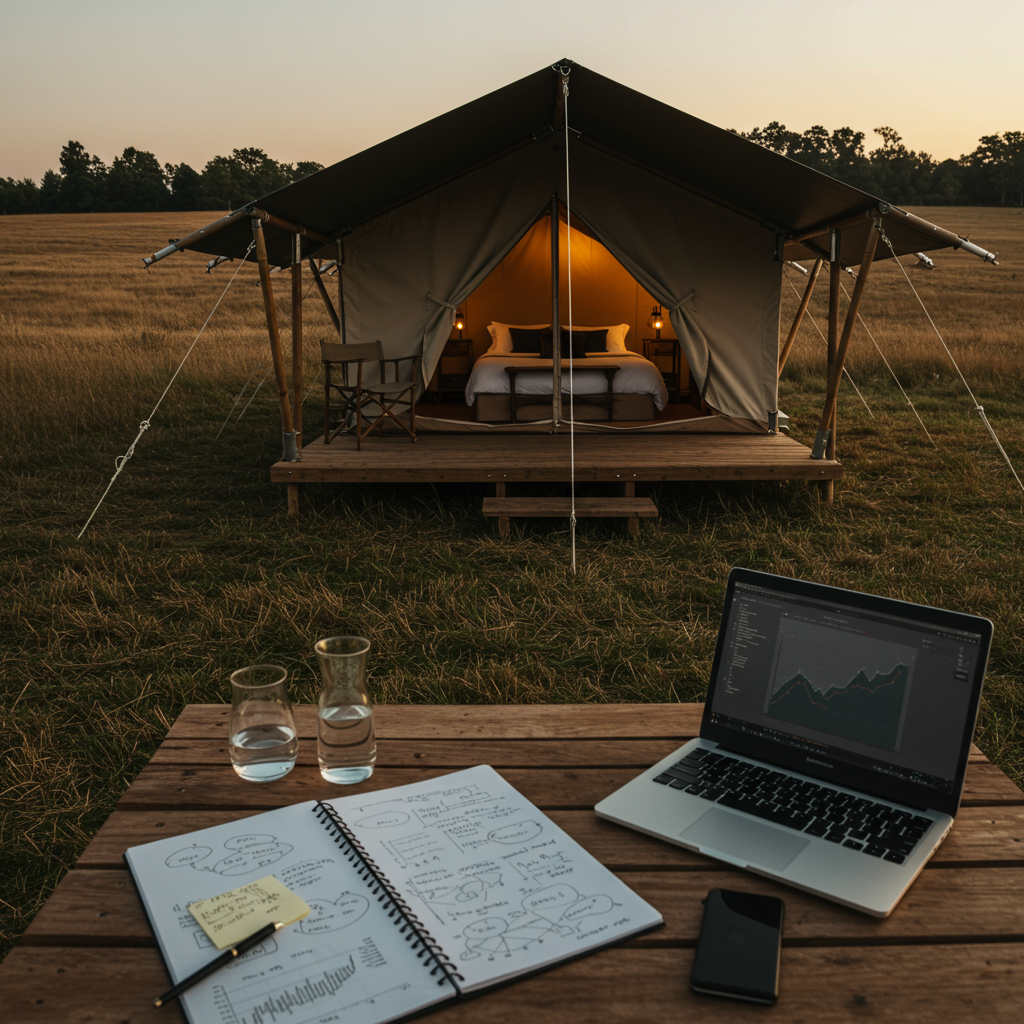
Stop believing that launching a highly profitable hospitality business requires purchasing prime, expensive real estate. We are diving into the burgeoning world of glamping, framing it not merely as a trend, but as a specific strategy for successful Undeveloped Land Investment—monetizing assets that everyone else dismisses. This article challenges the conventional real estate mindset, demonstrating how focusing on specific Niche Real Estate opportunities and mastering local markets allows you to execute a lucrative glamping business plan quickly and effectively, turning unconventional locations into reliable income streams.
Skip Expensive Land: Why Glamping Business is the Best Undeveloped Land Investment
Stop Chasing Prime Real Estate
When most people think about real estate investment, they imagine bidding wars for houses or buying expensive commercial lots in busy areas. This kind of prime real estate requires massive amounts of capital, takes years to develop, and carries inherent high risk. For new entrepreneurs, chasing the “perfect” piece of property is often a financial dead end.
Instead of competing for the most expensive land, smart investors look for opportunities where the barrier to entry is low. The Glamping Business allows you to completely bypass the need for road frontage, established utilities, or perfect zoning required by traditional residential or commercial builders. This crucial shift in thinking is the first step toward successful Undeveloped Land Investment.
Finding Hidden Profit in Overlooked Assets
The beauty of glamping lies in its ability to generate high revenue from assets that conventional developers ignore. Glamping doesn’t need flat, cleared acres. It thrives specifically on privacy, unique terrain, and natural features.
If a piece of property has beautiful views, dense woods, access to water, or rugged terrain, it is likely undesirable for building a standard housing development. However, these very features are precisely what glampers pay premium prices to experience.
By reframing these perceived “flaws” as desirable experiences, you unlock the profit potential in overlooked assets. This strategy turns marginalized land into a successful Niche Real Estate venture, proving that the land’s ability to host a unique experience is far more valuable than its readiness for conventional construction.
What Makes Land “Undeveloped” (And Why That’s Good)
In the context of real estate investment, undeveloped land typically means property lacking basic infrastructure like paved roads, sewer connections, public water, or established electrical grids.
For a traditional build, this lack of infrastructure is a massive expense. For a glamping setup, this lack of development translates directly into lower purchase costs and lower annual property taxes, fundamentally improving your return on investment timeline.
- Cost Savings: Undeveloped land is significantly cheaper, reducing your initial capital outlay and debt load.
- Faster Setup: High-quality glamping structures (like yurts or domes) often rely on off-grid solutions (solar power, composting toilets) or minimal utility extensions, meaning you don’t have to wait months or years for utility companies to connect the property.
- Privacy Value: The remoteness inherent in undeveloped land is a core selling point for glampers seeking true escape from urban life.
- Zoning: Is short-term rental activity permitted (e.g., in agricultural, recreational, or rural residential zones)?
- Health Department: Regulations regarding water access, sanitation (composting toilets, septic systems), and gray water management.
- Fire/Safety: Requirements for emergency vehicle access, clear egress from units, and approved heating sources (especially critical for year-round setups).
Understanding these economic advantages lays the foundation for building a robust and scalable income stream.
Building Your Niche Real Estate Income Stream
How Glamping Turns Simple Land into a High-End Stay
Glamping stands for “glamorous camping.” It’s a business model where guests pay hotel prices to sleep in nature. The key insight here is that you are selling a luxury outdoor experience, not just a structure.
A simple safari tent placed on a wooden deck becomes a high-end unit when paired with comfortable beds, quality linens, and thoughtful amenities like fire pits or private hot tubs. The focus is on providing comfort without sacrificing the connection to the wilderness.
The land itself effectively becomes the primary amenity. By creating stunning, comfortable spaces set within nature, you transform inexpensive Undeveloped Land Investment into a profitable Niche Real Estate venture capable of commanding average daily rates (ADRs) similar to those of boutique hotels. Operators often report boosting ADRs by 40-50% simply by adding features like private decks and high-end bathroom facilities.
Mastering Your Local Market Opportunity
Profitability in the glamping sector hinges on understanding where your potential customers are coming from and what specific experiences they seek. This requires mastering your Local Market Opportunity.
1. Identify Draw Factors: Are you near a national park, a popular hiking trail, a vineyard, or a bustling metropolitan area that needs a weekend escape? Glampers are looking for activities and specific environmental contexts.
2. Analyze Competition: If your area already has dozens of hotels or traditional campgrounds, how can your glamping concept stand out? Perhaps you offer specific luxury elements, theme your stays (e.g., wellness retreats), or target a completely different price point and demographic (e.g., pet-friendly or adults-only).
3. Define Your Audience: Are you targeting romantic couples, young families, or solo travelers? Tailoring the size and style of your structures to the local demand is crucial for maximizing occupancy and profit margins.
Choosing the Right Structures for Maximum Glamping Profit
Your choice of structure impacts your budget, permitting process, and potential nightly rate. When executing your Glamping Business, consider these options based on durability, aesthetic appeal, and cost:
| Structure Type | Pros | Cons & Considerations |
| :—————————- | :———————————————————————- | :—————————————————————————————— |
| Luxury Canvas Tents (Safari) | High profit margin, lowest initial setup cost, minimal foundation work required. | Lower durability and limited use in extreme weather; often seasonal. |
| Geodesic Domes | Highly unique, weather-resistant, commanding high nightly rates due to novelty. | Higher upfront material cost and potentially more complex engineering/anchoring. |
| Tiny Cabins/A-Frames | Highest durability, capable of year-round use, potentially the simplest permitting in certain zones. | Highest material cost, slower construction time, may require traditional utility hookups. |
The most successful glamping operations focus on structures that require minimal site modification while offering a unique, premium aesthetic. Remember, the profit comes from delivering luxury features (like a real shower or efficient heating) within a rugged natural setting.
Entrepreneurial Execution: Launching Your Profitable Glamping Venture Fast
Quick Steps to Secure the Right Location
Speed and efficiency are crucial for successful Entrepreneurial Execution in this market. Delaying the launch means delaying revenue generation.
1. Prioritize Scenery Over Accessibility: Don’t waste time looking for land with perfect paved access. Focus on natural beauty and seclusion—the things that sell the experience.
2. Look for Seller Financing: Since the land is undeveloped and deemed risky by traditional banks, seek out sellers who are willing to finance the purchase themselves. This dramatically reduces the capital needed to start and speeds up the acquisition process.
3. Verify Zoning: Before purchasing, ensure the local zoning allows for short-term rentals or recreational accommodations. This is a non-negotiable step that should be handled early via a quick consultation with the county planning office.
Understanding Permits for Your Glamping Business
Permitting is often the largest hurdle entrepreneurs fear, but with glamping, it can be significantly simplified. Because many glamping structures are classified as temporary, removable, or accessory structures (depending on the jurisdiction), they may fall under different, less stringent regulations than permanent buildings.
Key areas to investigate immediately:
Consulting a local planning officer early on can save significant time and money, ensuring your Glamping Business is compliant from day one and avoiding costly rework down the line.
The Power of Acting Now (Don’t Overthink the Launch)
The most successful entrepreneurs in the Niche Real Estate space are often those who prioritize action over endless planning. The temptation is to wait until you have the perfect design, the highest-end fixtures, and five flawless units ready.
Resist this urge. Start small. Launch with two well-designed units and scale up based on the actual demand you observe and the revenue you generate.
Rapid execution allows you to:
1. Test the Market: See what unit styles, amenities, and price points work best in real time, gathering valuable guest feedback to optimize future builds.
2. Start Generating Cash Flow: Revenue from your first units can fund the development of subsequent units (often fully funding expansion after the first high season), lowering your long-term financial exposure.
3. Establish a Brand Presence: Get your listing visible online quickly to secure early bookings and build momentum, often resulting in higher occupancy rates than competitors who delayed their launch.
The market for unique, outdoor lodging is booming. Don’t let the fear of bureaucracy or the pursuit of perfection prevent you from capitalizing on this valuable Undeveloped Land Investment strategy today.
Conclusion
Glamping offers a powerful alternative to traditional real estate investment, repositioning scenic, undeveloped land as a high-value asset. By prioritizing unique natural settings and off-grid solutions over expensive infrastructure, investors can drastically reduce capital outlay and accelerate time to market. This niche strategy transforms low-cost acreage into profitable ventures capable of commanding boutique hotel rates through the delivery of luxury outdoor experiences.
Success hinges on mastering local market opportunities, making smart structure choices, and executing a streamlined launch focused on immediate cash flow generation. The luxury outdoor lodging market continues to expand rapidly, proving that the greatest return often lies not in building conventional structures, but in curating unforgettable natural escapes within secluded landscapes.