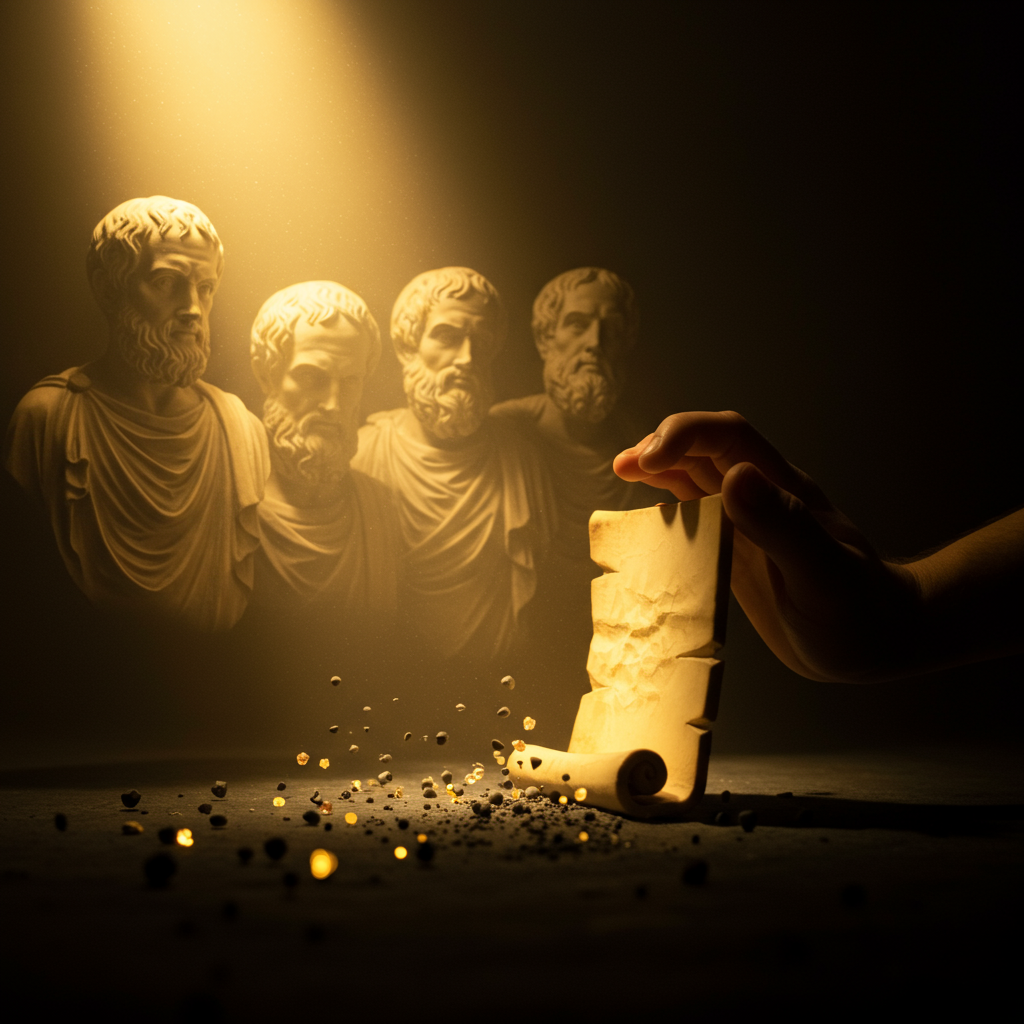
Imagine a scientific idea so fundamental to modern life—the concept of discrete particles and the void—that it was actively rejected and suppressed for two millennia by the very giants of classical philosophy. We often celebrate the major scientific revolutions of the Renaissance, but the true foundational conflict occurred centuries earlier, when figures like Aristotle and Plato cemented the view that matter was continuous, establishing a philosophical opposition that effectively sidelined ancient atomic theory. Their highly rational systems rejected the notion of empty space and based reality on “matter and form,” creating a comprehensive yet flawed view of physics that separated the heavens from the Earth and dominated scientific inquiry for millennia. By tracing the historical and philosophical battle that caused this 2,000-year delay, this article uncovers one of the most critical yet least discussed examples of a paradigm shift in intellectual history, providing crucial insight into how deeply philosophical assumptions can dictate the pace and direction of scientific progress.
Early Ideas of Atoms and the Void
The earliest attempt to fundamentally explain the nature of reality stemmed from the pre-Socratic philosophers, notably Leucippus and Democritus. These thinkers introduced the concept that everything in the universe is composed of two fundamental entities: atoms and the void, a view that formed the first comprehensive atomic theory.
Ancient Atomists: Everything is Particles and Empty Space
The core idea of the ancient atomists was revolutionary for its time, providing a purely materialistic and mechanical explanation for the physical world. They posited that atoms (from the Greek atomos, meaning “uncuttable”) were invisible, eternal, solid particles differing only in shape, arrangement, and size. All observed changes, from growth to decay, were merely the result of these atoms rearranging themselves. Crucially, they argued for the existence of void, or absolute empty space, necessary for atoms to move, collide, and combine. This allowed for change and motion without invoking gods or abstract forces, relying instead on mechanical principles.
Why Early Atomic Motion Was Hard to Explain
While this view explained composition, it struggled profoundly to account for organized motion and the creation of stable, complex structures. If atoms were truly just moving randomly in a perpetual fall, how did they ever aggregate to form something as specific as a living creature?
Later atomists, understanding this weakness, attempted to refine the model. Epicurus and Lucretius introduced the concept of the clinamen, or the “swerve.” This was a tiny, unpredictable, spontaneous deviation in the trajectory of falling atoms, necessary to allow them to collide and aggregate. However, critics argued that invoking the swerve introduced randomness and undermined the strict, systematic logic favored by subsequent classical philosophy. This difficulty in describing coherent, stable structures and consistent motion made early atomic models vulnerable to powerful philosophical rejection.
This vulnerability of the atomists’ mechanistic view soon confronted the intellectual rigor of Athens’s greatest thinkers.
Classical Philosophy’s War Against Atoms
The zenith of ancient Greek philosophy produced intellectual systems from Plato and Aristotle so comprehensive and compelling that they effectively displaced atomic theory, establishing a new intellectual framework that would endure for millennia. This constituted a critical philosophical opposition to particulate matter.
Plato’s Realm of Forms: Defining Matter with Perfect Geometry
Plato offered the first major challenge, dismissing atoms because they lacked the mathematical perfection required for true reality. He argued that the sensible world is imperfect; true reality resides in the eternal, perfect Realm of Forms.
For Plato, matter was defined not by random particles, but by geometry. In his dialogue Timaeus, he defined the four basic elements using specific Platonic solids, thereby linking matter directly to rational thought and mathematical elegance: Earth was defined by the stable Cube, while Fire was represented by the sharp Tetrahedron. This geometric definition of substance was superior, in Plato’s view, because it offered order and reason, effectively sidelining the untidy, random collisions inherent in the atomic view.
Aristotle’s Philosophical Opposition to the Existence of Void
The most powerful and historically consequential rejection came from Aristotle, whose system became the foundation of Western physics for centuries. Aristotle rejected atoms and, definitively, rejected the existence of void based on his robust model of motion.
His opposition was founded on two pillars of his terrestrial physics:
1. The Problem of Infinite Speed: Aristotle argued that motion requires resistance (like air friction). If an object moved through a perfect vacuum (the void), there would be zero resistance. This would necessitate movement at infinite speed, a logical impossibility in his system.
2. The Necessity of Place: Motion, for Aristotle, was defined as an object striving toward its natural resting place (e.g., Earth objects striving toward the center of the universe). The void, being the complete absence of matter, could offer no inherent place or direction, making coherent movement impossible.
Because the void was incompatible with his observations of motion on Earth, Aristotle declared it could not exist. Since atoms required the void to move and rearrange, the entire premise of atomic theory was logically eliminated from serious consideration.
The 2,000-Year Shift: The Continuous Matter Paradigm
The unified intellectual authority of Plato and Aristotle led to the abandonment of particulate matter, consolidating a continuous view of substance that represented a foundational intellectual paradigm shift in history, stalling scientific progress in understanding matter’s structure.
Defining Reality by Continuous Matter and Form
Aristotle’s model provided an integrated, organized cosmology that successfully replaced the atomists’ random model. This dominant paradigm defined reality not by indivisible particles, but by two concepts: Continuous Matter (substance that is unbroken and infinitely divisible) and Form (the essence or purpose defining what that matter is). A lump of clay and a finished statue might be made of the same matter, but their specific forms distinguish them.
This framework also solidified the split between terrestrial physics (laws governing continuous matter and change on Earth) and celestial physics (the perfect, unchanging realm of the heavens). This dualistic, continuous matter model held sway through the Roman Empire and the Middle Ages, offering a logically sound and theologically compatible view of the cosmos that required no empty space.
How This Conflict Became a Critical Paradigm Shift in History
This conflict between the ancient atomists (particulate, void-based) and the classical philosophers (continuous, form-based) is one of history’s most profound examples of a paradigm shift. The philosophical victory of Aristotle was so complete, and his framework so deeply woven into early European academic and religious thought, that it effectively halted scientific inquiry into the structure of matter for nearly 2,000 years.
Instead of testing for particles, scholars accepted the established rational proof that atoms and the void were impossibilities. The sheer scale of this intellectual delay—two millennia—illustrates how deeply fundamental philosophical assumptions can dictate the direction of science, blocking empirical investigation until the Scientific Revolution revived the concepts of particulate matter and the necessary existence of void in the 17th century.
Conclusion
The historic conflict over the structure of matter pitted the mechanistic worldview of the ancient atomists against the ordered philosophical elegance of Plato and Aristotle. While the concept of atoms and the necessary void offered a material explanation for change, its vulnerability regarding organized motion allowed classical philosophy to prevail. Aristotle’s decisive rejection of the void, deemed logically impossible within his physics, established a robust Continuous Matter Paradigm based on Form and infinite divisibility.
This philosophical victory fundamentally altered the trajectory of Western thought, delaying serious scientific inquiry into particulate matter for two millennia. The narrative of the atoms’ rejection serves as a profound illustration of how deeply fundamental assumptions, when intellectually compelling and widely accepted, can dictate the direction of knowledge, underscoring the vital need for continuous empirical testing to challenge even the most established rational proofs.